

The Strategy Stress Test
Why Strategies Fail Before Execution Begins (and how to avoid fatal mistakes)


Reading time: 17 minutes
STRATEGIC INSIGHT
The Problem: When strategies fail, the dominant explanation is execution. The organization could not deliver. Accountability was unclear, culture resisted, middle management did not align. The remedy prescribed is always operational: better governance, clearer performance management, stronger implementation discipline.
The Challenge: This explanation is often wrong. Over more than twenty years of working with leadership teams on strategy design and execution, a different pattern emerges consistently. Strategies fail because they were weak to begin with. Weak strategies produce poor execution — not the other way around. The problem is upstream, and no amount of execution improvement can compensate for a strategy that was never sound.
The Solution: The Strategy Stress Test is a three-level framework for evaluating strategy quality before execution begins. It tests whether a strategy actually exists, whether it is coherently designed, and whether it has the competitive power to win. Leaders who apply it before committing resources address the real problem rather than its downstream symptoms.
EXECUTIVE SUMMARY
Strategy quality is one of the most neglected disciplines in organizational life. Leaders invest heavily in strategy processes — analysis, facilitation, alignment workshops, cascade communications — yet apply almost no rigorous standard to evaluating whether those processes produce strategy that deserves the name.
The result is a persistent and costly pattern: organizations execute with discipline in directions that were never strategically sound, then diagnose the failure as an execution problem. The strategy is not questioned. The cycle repeats.
The Strategy Stress Test breaks that cycle. It organizes strategy evaluation into three progressive levels:
Strategic Validity, which tests whether a strategy actually exists;
Strategic Integrity, which tests whether it is coherently and completely designed; and
Strategic Power, which tests whether it can generate competitive advantage.
Each level must be passed before the next becomes meaningful. Failure at any level, left undetected, compounds into execution problems that no operating model can fix.
This article introduces the framework, explains why organizations systematically fail at each level, and provides the diagnostic questions leaders need to evaluate strategic quality before resources are committed and organizational energy is spent.
When strategies fail, we blame execution. The strategy was sound, the argument goes — the organization simply could not deliver it. Accountability was unclear. Culture resisted change. Middle management did not align. The remedy, accordingly, is better implementation: clearer governance, stronger performance management, more rigorous operating rhythms.
This explanation is wrong. Or rather, it is an answer to the wrong question.
In more than twenty years of working with leadership teams on strategy design and execution, a different pattern emerges consistently. When strategies fail, the cause is rarely an organization that could not execute. It is a strategy that was not worth executing. The execution machinery runs — faithfully, sometimes brilliantly — toward an objective that was never strategically sound, and produces, with considerable efficiency, results that disappoint.
Weak strategies produce poor execution. Not the other way around.
This distinction matters because it changes where leaders must focus their attention. If execution is the problem, the remedy is operational: tighten the governance, clarify the accountabilities, and build the operating model. If strategy quality is the problem, none of that works. You cannot execute your way out of a strategy that does not address the right challenge, does not make real choices, or lacks the competitive power to win. Every improvement in execution capability simply accelerates movement in the wrong direction.
Yet strategy quality is almost never evaluated before organizations commit to execution. Strategy processes produce documents. Leadership teams endorse them. Execution begins. Whether the strategy actually addresses a specific challenge, makes genuine trade-offs, or could realistically beat the competition — these questions are rarely asked with rigor before the resources are spent and the organizational commitments are made.
The Strategy Stress Test is a framework for identifying that weakness before it becomes expensive. It evaluates strategy quality across three distinct levels — existence, design, and competitive power — and locates precisely where strategic quality breaks down. It does not design strategy. It tests it. And that test, applied before execution begins, is one of the highest-leverage acts available to a leadership team.
The Quality Problem Nobody Is Solving
Strategy quality degrades in organizations for reasons that are structural, not accidental — and that is precisely why leaders so rarely notice when it does.
The most fundamental problem is definitional. Most organizations do not have a working definition of strategy precise enough to distinguish it from adjacent activities. When leaders call something a strategy, they may mean a vision for the future, a set of financial targets, a portfolio of improvement initiatives, or a plan for the next three years. These things are not strategies. They are the organizational activities that surround strategy.
Strategy, defined with precision, is a coherent approach to overcoming a specific and significant challenge. It makes choices about where to focus, how to compete, and what to deliberately not pursue. It provides a causal logic: here is the challenge, here are the choices made in response, and here is why those choices should produce the results required. When that definition is applied rigorously, most strategy documents do not pass the test.
— IMPORTANT DISTINCTION — A goal and a strategy are not the same thing. A goal defines what you want to achieve. A strategy defines how you intend to win given the specific challenge you face. “Grow revenue by 20%” is a goal. “Focus on mid-market enterprise customers in three geographies where our service model creates a structural cost-to-serve advantage competitors cannot match” is the beginning of a strategy.
Three structural forces drive quality degradation even in organizations with sophisticated leadership teams.
The first is the pressure for inclusion. When every function and business unit contributes to strategy, the natural output accommodates everyone’s priorities. Trade-offs are softened. Choices that would exclude certain initiatives are avoided. The result is a strategy that is politically coherent but strategically incoherent — one that has not made the difficult choices that real strategy requires.
The second is inverted risk aversion. Organizations often take on excessive strategic risk not by being bold, but by refusing to choose. A strategy that does not commit to specific markets, customers, or competitive positions remains perpetually plausible because it has never been made falsifiable. Leaders experience this as safety. It is a form of strategic negligence.
The third is the absence of a quality standard. Financial reporting has standards. Clinical trials have standards. For almost every consequential organizational activity, there is a defined quality threshold that must be passed before resources are committed. There is no equivalent standard for strategy. The process produces a document. The document is endorsed. Execution begins. Whether the output deserves the name strategy is a question that never gets formally asked.
— HISTORICAL NOTE — The idea that strategy requires genuine trade-offs was developed most rigorously by Michael Porter in his 1996 Harvard Business Review article “What Is Strategy?” Nearly thirty years later, most strategy processes still do not systematically test for whether real trade-offs have been made.
The Strategy Stress Test addresses these problems directly. It does not redesign the strategy process. It installs a quality standard at the end of it.
The Strategy Stress Test
The framework evaluates strategy quality at three progressive levels. Each level answers a distinct question. Each must be passed before the next becomes meaningful.
A strategy that fails the first test does not have a strategy quality problem. It has a strategy existence problem. A strategy that passes the first test but fails the second is present but poorly designed. A strategy that passes the first two tests but fails the third is coherent but not competitive. The distinctions matter because each failure type requires a different response.
Level → Question → Failure Result
Strategic Validity → Do we actually have a strategy? → No strategy
Strategic Integrity → Is it coherently designed? → Bad strategy
Strategic Power → Could it realistically win? → Weak strategy
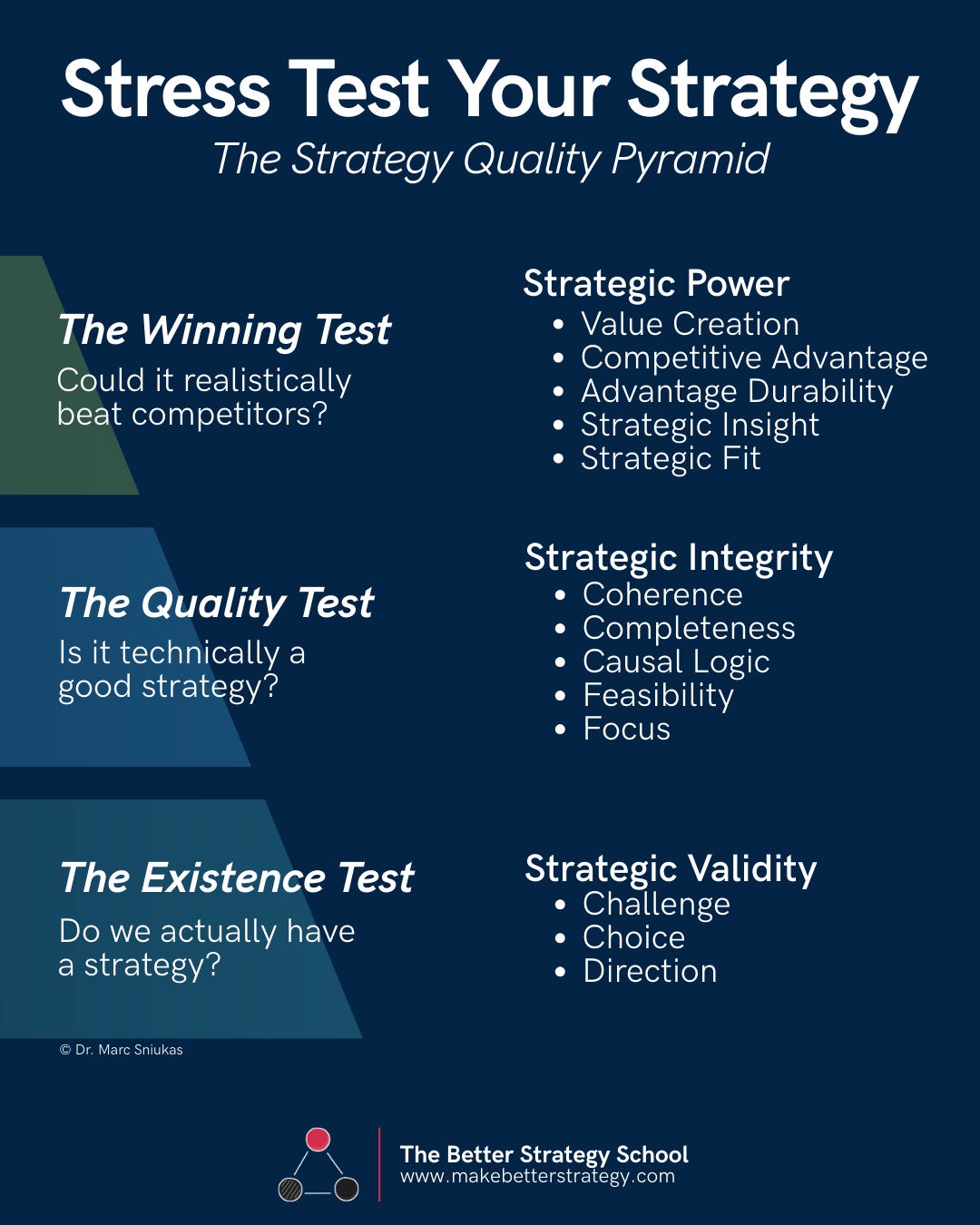
Test One: Strategic Validity — Do We Actually Have a Strategy?
The first test asks the most fundamental question: does what the organization calls its strategy actually qualify as one?
This question is less straightforward than it appears.
Strategic Validity requires three conditions to be present.
The first condition is that the strategy addresses a real and significant challenge. Strategy begins with diagnosis. The organization must have identified the specific obstacle standing between its current position and its ambitions — what Richard Rumelt calls the crux, the pivotal challenge whose resolution would unlock progress. Without that diagnosis, strategy has no problem to solve. It becomes an optimistic description of a desired future with no theory of how to reach it.
The second condition is that the strategy makes real choices. Choices that cost nothing are not strategic. A genuine strategic choice forecloses alternatives, concentrates resources, and creates trade-offs. When an organization claims it will compete on quality, cost, and service simultaneously — without differentiation between them — it has not made a strategic choice. Strategic choices are recognizable precisely because they create discomfort: someone in the organization wanted a different choice and did not get it.
The third condition is that the strategy provides direction. It must give people across the organization a basis for making decisions consistent with the strategic logic. When strategy functions as a coordinating mechanism, frontline managers can evaluate new opportunities against it without escalation. When the question “does this fit our strategy?” generates genuinely different answers at different levels of the organization, the strategy has not yet achieved the directional clarity the first test requires.
— STRATEGY MYTH — “Strategy execution” is a discipline separate from strategy design. Execution problems almost always reveal design problems. When organizations cannot align behind a strategy, when initiatives proliferate without coherence, when priorities conflict at the operating level — these are not execution failures. They are the downstream consequences of a strategy that failed the validity test. There was no clear challenge, no real choice, no direction strong enough to coordinate action. Execution machinery cannot compensate for what strategy design did not provide.
Three diagnostic questions test for Strategic Validity.
Does the strategy clearly address the key challenge the organization must overcome?
Does it make explicit choices and trade-offs?
Does it provide clear direction that guides decisions and actions across the organization?
If any of these cannot be answered positively, the organization does not yet have a strategy. It has material from which a strategy could be developed.
Test Two: Strategic Integrity — Is It Well Designed?
A strategy can exist — addressing a real challenge, making genuine choices, providing directional clarity — and still be poorly designed. Strategic Integrity evaluates the internal quality of the strategy. It tests whether the strategy is coherent, complete, causally logical, feasible, and focused.
Coherence is the foundational quality. The elements of a strategy must reinforce one another. Choices about which markets to enter, which capabilities to build, and which activities to pursue should form a mutually reinforcing system. When they do, the strategy has what Michael Porter calls “fit” — the pieces amplify each other’s effectiveness. When they do not, the strategy is structurally vulnerable: competitors can attack individual components without having to overcome the whole.
Southwest Airlines built its strategy around a set of mutually reinforcing choices: short-haul routes, single aircraft type, no assigned seating, fast turnarounds, point-to-point routing, and direct booking. Each choice made the others more powerful. Fast turnarounds required a single aircraft type. Low costs required fast turnarounds. Point-to-point routing enabled fast turnarounds. The system as a whole was far more defensible than any individual element. Competitors could imitate pieces of it. Replicating the entire system would have required them to dismantle their own strategic models (See Michael Porter “What is Strategy?” HBR Nov-Dec 1996 for a full explanation).
Completeness is the second quality. A strategy must answer the essential questions for its context. A business strategy, at minimum, clarifies where the organization will compete — which customers, which offerings, which geographies — and how it will succeed in those arenas. It identifies the capabilities required and describes how the organization will support the strategic choices made. Strategies that leave critical questions unresolved create a predictable failure pattern: each unresolved question becomes a decision point during execution, made without strategic guidance, producing inconsistency and fragmentation at the operating level.
— IMPORTANT DISTINCTION — Strategic completeness varies by type. Ecosystem strategies, corporate strategies, business strategies, and functional strategies each have their own essential questions. An incomplete strategy does not produce execution failure immediately. It produces a cascade of undirected decisions that accumulate into failure over time.
Causal logic is the quality most frequently absent. A strategy must contain an explicit theory of why it will work. This logic connects the challenge the organization faces, the choices it is making in response, and the results those choices are expected to produce. Without it, strategy becomes assertion rather than reasoning. When challenged — by new competitive data, by board scrutiny, by market shifts — a strategy without explicit causal logic cannot be defended on its own terms.
Amazon Web Services illustrates strategic causal logic in action. The insight was that the infrastructure investment required to build scalable digital businesses created a structural inefficiency: most organizations were building capabilities they would only partially use. The logic was explicit and connected: if Amazon built infrastructure at scale, the unit economics would favor it over any individual organization building for itself. If it offered that infrastructure as a service, integration depth would create switching costs. If it priced aggressively, adoption would accelerate before competitors could match its scale. Each element connected to the others through deliberate reasoning. That reasoning could be tested against market reality.
Feasibility requires alignment between strategic ambition, available resources, and organizational capability. A strategy that requires capabilities the organization cannot realistically develop in the relevant time horizon will fail regardless of its elegance. This is not a counsel of conservatism — ambitious strategies are often correct. It is a requirement that the gap between current capability and required capability be named explicitly and addressed as part of the strategic logic, not deferred to execution.
Focus is perhaps the most undervalued quality of effective strategy. The organizations that execute strategy most powerfully are almost always those that have made the hardest choice: deciding what not to pursue. Spreading strategic attention across too many priorities is not a strategy — it is a list of intentions. Focus requires leadership teams to make the concentration choices that strategy demands, even when those choices disappoint stakeholders with competing priorities.
Five diagnostic questions test for Strategic Integrity.
Do the elements of the strategy reinforce each other and form a coherent system?
Does the strategy answer the key questions of where to compete and how to succeed?
Is there a clear logic explaining why the strategy will work?
Is the strategy feasible given the organization’s resources and capabilities?
Does the strategy concentrate effort on a small number of decisive priorities?
If these tests fail, the organization might have a strategy, but it is poorly designed.
Test Three: Strategic Power — Could It Actually Win?
Even a strategy that passes the validity and integrity tests may still fail if it cannot produce competitive advantage. Strategic Power evaluates whether the strategy has the potential to generate superior performance in the market. It moves from internal quality to external fit — from how the strategy holds together to whether it can win against the competition that actually exists.
Value creation is the foundation. The strategy must create meaningful value — for customers, for the organization, and within the broader ecosystem in which it operates. Value creation is the precondition for competitive advantage. Without it, there is no reason for customers to choose the organization over alternatives, and no basis for sustainable returns.
Competitive advantage is the central condition. Advantage arises when the strategy leverages asymmetries that competitors cannot easily match. These asymmetries may be structural — cost advantages, scale economies, privileged access to resources or channels. They may be capability-based — distinctive skills, proprietary processes, organizational knowledge that competitors would take years to develop. They may be positional — a brand, a network, a customer relationship that creates switching costs. What they share is this: they create a gap between what the organization can achieve and what a competitor following a similar logic could achieve.
Without such asymmetries, the strategy can produce competitive parity at best. Parity is not a winning position. In most markets, parity means gradual erosion as more aggressive or more focused competitors find the gaps.
Advantage durability is the condition most frequently underestimated. Many strategies look powerful in isolation. They look considerably less powerful once competitive response is modeled seriously. The test is not whether the strategy is winning now. It is whether it is structured to continue winning as competitors respond.
Walmart’s early competitive advantage was built on a logistics and distribution system technically superior to any competitor’s in its era. The durability of that advantage came not from the technology itself — which competitors could in principle replicate — but from the combination of scale, supplier relationships, and operating discipline that made the system function as an integrated whole. By the time competitors understood what Walmart had built, Walmart had extended it further. The advantage compounded because its components were interdependent. Imitating one element did not replicate the system.
Durability may arise from scale economies that widen as volume grows, network effects that become more valuable with each additional user, learning advantages that compound over time, or complex capabilities that require years to develop. Strategists must consider how competitors are likely to respond. A strategy that looks powerful in isolation may collapse once competitors react. This does not require predicting the future with certainty. It requires thinking seriously about whether the strategy will hold up against the competitive forces it will encounter.
Strategic insight is the rarest condition and often the source of the most powerful strategies. Many breakthrough strategies originate in an insight others have not yet recognized: a new understanding of customer behavior, an overlooked structural opportunity, a proprietary observation about how the competitive landscape is shifting. This insight allows the organization to see and act before markets price the opportunity away.
Netflix’s strategic insight was not that streaming was the future of entertainment — that was widely understood. The insight was that content ownership, combined with data-driven curation at scale, would create a switching cost and a production advantage that distribution-only competitors could not replicate. That insight shaped every major strategic decision the company made for a decade: the move into original content, the investment in recommendation algorithms, the global expansion sequencing. The strategy was powerful not because it was well executed, but because the insight on which it was built was genuinely distinctive.
Strategic fit completes the power assessment. The strategy must align with the structural realities of the external environment. Even a strategy with strong internal logic struggles if it ignores the profitability dynamics of its industry, enters segments where structural forces suppress returns, or assumes customer behavior that does not yet exist at scale. Competitive power requires alignment between strategic choices and the external conditions in which those choices will play out.
Five diagnostic questions test for Strategic Power.
Does the strategy create meaningful value for customers and the organization?
Does it establish a competitive advantage by leveraging asymmetries?
Will that advantage hold once competitors respond?
Is the strategy grounded in insight about the market or competitive landscape that others have not yet recognized?
Does it fit the structural realities and trends of the external environment?
If these questions cannot be answered convincingly, the strategy is not yet a winning strategy.
What Leaders Must Do Differently
The Strategy Stress Test is a diagnostic instrument. Its value lies not in understanding the framework but in applying it — rigorously, honestly, and at the right moment in the strategy cycle. That application requires three leadership commitments.
Apply the stress test before execution begins. The most costly moment in strategic practice is when organizations commit resources and organizational energy to executing a strategy that has not been tested for quality. The cost of a flawed strategy compounds rapidly once execution begins: people are hired, processes are built, stakeholders develop commitments, and the organizational cost of changing course rises with each passing month. The stress test’s value is highest at the beginning of the cycle, before those commitments are made.
The diagnostic questions at each level are designed to be worked through by the leadership team together, not by a strategy function in isolation. When a leadership team applies the Strategic Validity questions and finds that members hold genuinely different views about which challenge the strategy addresses, or whether real trade-offs have been made, that disagreement is not a problem. It is precise and actionable information. It reveals exactly where the strategy has not yet achieved the quality it requires. The purpose of the exercise is not to validate the strategy. It is to identify where its quality is weakest so that attention can be concentrated there before execution begins.
Treat strategic quality as a leadership responsibility, not a process output. One of the most persistent failures in organizational strategy is the belief that quality is produced by the process — that a rigorous planning methodology, facilitated by skilled advisors, will produce a high-quality strategy as a natural output. This belief relieves leaders of the most demanding aspect of their role: the exercise of judgment about whether the strategy being developed meets the standard required.
The stress test shifts that accountability directly to the leadership team. The questions it poses cannot be answered by consultants or planning teams. They require the leadership team to make explicit judgments about the nature of the challenge, the reality of the choices being made, the causal logic of the strategy, and the basis for competitive advantage. These are leadership acts. They cannot be delegated.
Use the stress test to diagnose failure, not only to validate success. The most productive application of the framework is often retrospective: applying it to strategies that are underperforming to identify exactly where quality breaks down. When strategies consistently miss their targets, the stress test provides a diagnostic sequence. Validity failure means there was no real strategy to execute. Integrity failure means the strategy was present but poorly designed — execution improvement will produce temporary gains followed by regression. Power failure means the strategy was coherent but not competitive.
Each failure type requires a different response. Conflating them — applying execution remedies to design problems, or design remedies to existence problems — is itself a form of strategic confusion. The stress test makes the distinction visible.
That sequence — quality first, execution second — is the discipline the Strategy Stress Test is designed to institutionalize. Not as a bureaucratic review, but as a leadership standard: the expectation that before an organization commits its resources and its people to a direction, it has tested that direction with the rigor the commitment deserves.
Most organizations already have the execution capability they need. What they lack is the strategic quality to direct that capability effectively. The machine is running. The question is whether it is running toward something that has been genuinely examined — a strategy that exists, that is coherently designed, and that has the competitive power to win.
That examination is not a planning exercise. It is a leadership responsibility. And the organizations that take it seriously are the ones that stop repeating the same cycle — strong execution, disappointing results, execution blamed — and start building strategies that deserve to be executed.
The standard is not perfection. It is seriousness. The Strategy Stress Test is what seriousness looks like in practice.
Dr. Marc Sniukas is the founder of The Better Strategy School and a strategy advisor to leadership teams worldwide. Through his writing, teaching, and advisory work, he helps leaders design and execute better strategies that actually work in the real world.
The Better Strategy School helps leaders and organizations develop strategy as a core leadership capability. Through rigorous thinking, practical frameworks, and real-world application, it teaches professionals how to design, decide, and lead better strategies.